


7 Steps to Redesign Work That Keeps Teams Growing
A quiet moment happens in many teams right after a successful automation rollout. The dashboards look cleaner. The queue shrinks. People breathe easier.
Then, a few months in, growth flattens. Engagement dips. New ideas show up less often. The work didn’t get worse. However, it just stopped stretching anyone.
A skills plateau rarely announces itself. It creeps in when automation quietly strips away the tasks that used to stretch people, leaving them comfortable but no longer growing. The moment a role stops demanding new thinking, that’s when stagnation begins.
This is why elevating roles matters as much as automating tasks. Done well, it helps people learn faster, contribute more, engage more, and grow better.
Keep reading to learn how to stop a skills plateau in your organization and keep your team always growing.
Understanding Skill Plateau in the Automated Workplace
A skills plateau happens when people stop getting better at their jobs because their work no longer requires new skills. When variety and challenge drop, growth slows.
Automation changes that equation faster every year. The proof is in the numbers:
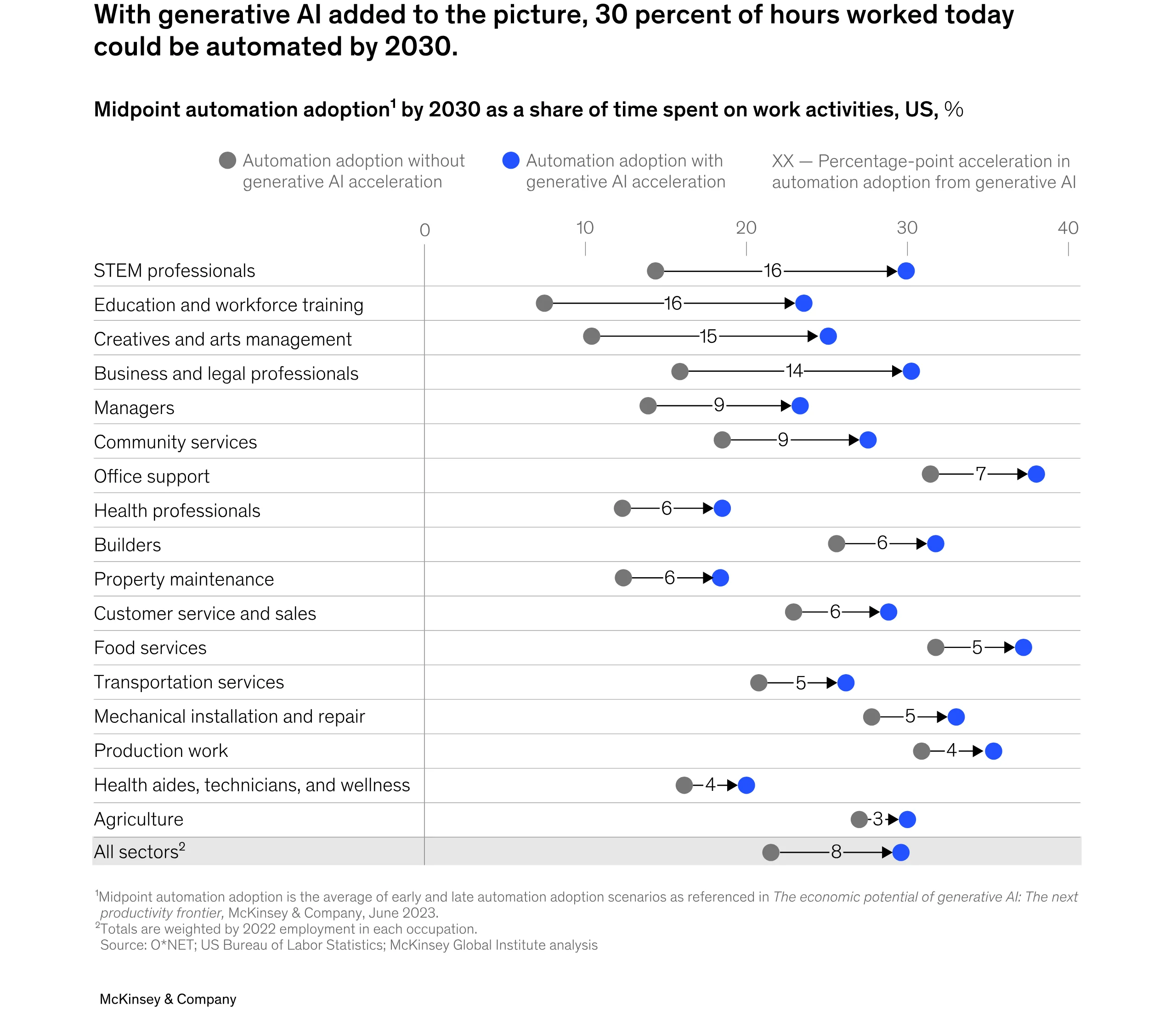
- McKinsey estimates that generative AI could automate activities accounting for up to 30% of hours worked by 2030. This is especially true in knowledge-heavy roles that once felt automation-proof.
- Meanwhile, the World Economic Forum (WEF) projects that nearly 45% of workers’ skills will be disrupted in the next five years.
There’s a difference between roles that are automated and roles that are elevated:
- Automated roles hand off tasks to machines and call it a day.
- Elevated roles use automation to create space for higher-value work: tougher judgment calls, creative problem-solving, deeper customer empathy.
Early research backs this up: when AI-assisted customer support agents used AI, overall productivity rose by 14% on average. The biggest gains go to less-experienced workers who could learn from AI’s guidance in the flow of work.
How To Redesign Work That Keeps Teams Growing
1. Identify core responsibilities that require human expertise
Start simple: figure out which parts of the job must stay human. Get this wrong, and you automate the very stretch work that builds judgment and craft.
Look for work that hinges on:
- Context and ethics – trade-offs, trust, safety, and brand nuance
- Complex synthesis – connecting dots across messy inputs
- Relationship building – coaching, negotiation, calming tense moments
- Original creation – new narratives, designs, experiments
Automate the ‘repeatable.’ Guard the ‘developmental.’
2. Invest in upskilling and reskilling programs
If skill requirements change faster than your learning systems, obsolescence wins. That’s why you have to offer upskilling and reskilling programs.
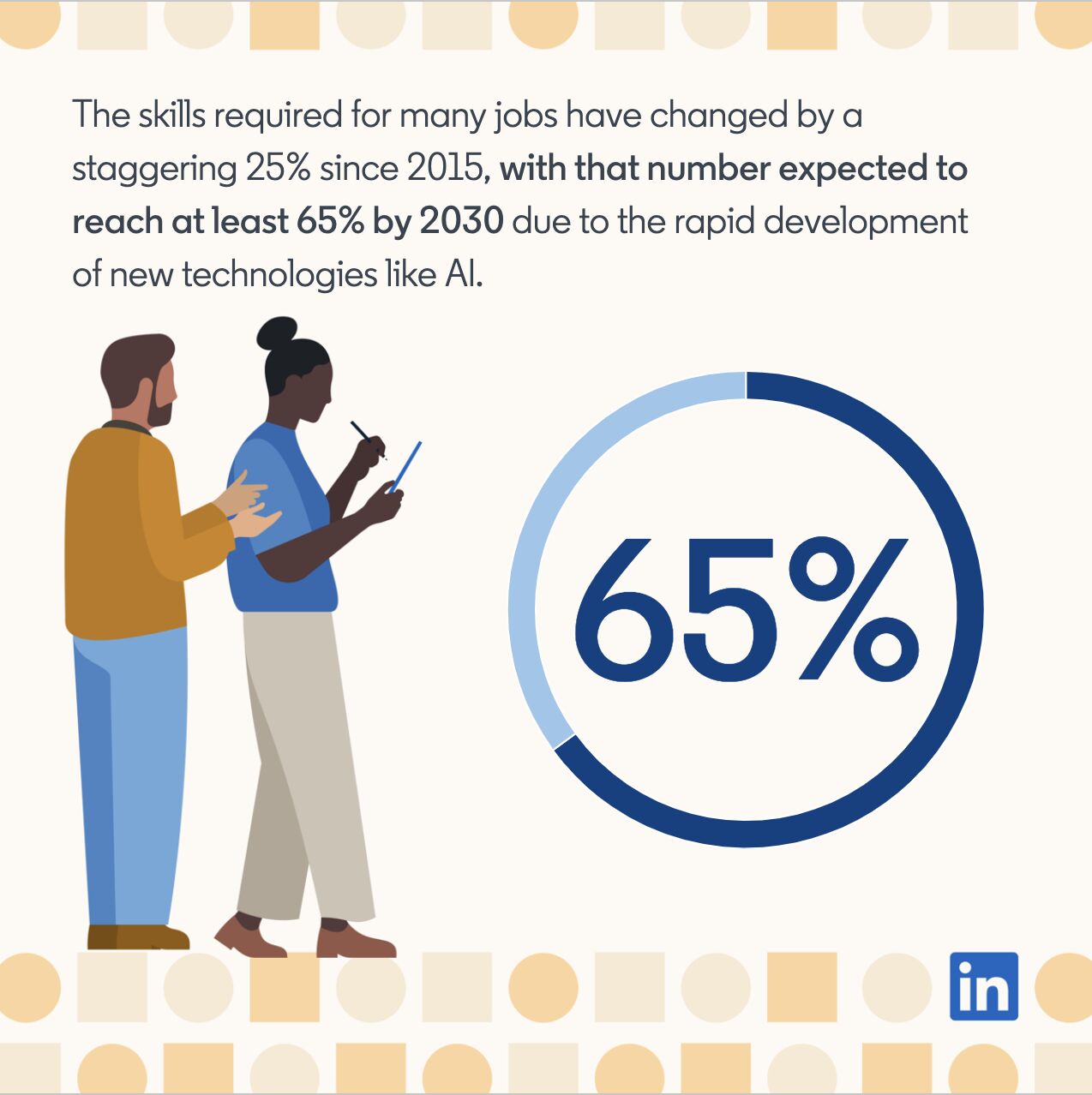
LinkedIn’s research shows the skill set for many jobs has changed by roughly 25% since 2015 and could reach 65% by 2030. That speed makes one-off training nearly useless.
Source: LinkedIn AI worktrends
Upskilling can’t be a one-off event squeezed in when there’s spare time. Whether it’s online courses or hands-on workshops, learning has to be woven into the everyday rhythm of work. When employees see a clear path to grow, automation stops feeling like a threat and starts feeling like a springboard.
Blend formats so learning sticks:
- Micro-courses – for quick, just-in-time skills
- Deep-dive workshops – for complex tools or methods
- Mentorship and peer learning circles – for judgment and tacit knowledge
- Project rotations – to apply new skills fast
Make space for it on the schedule. If it’s not on the calendar, it won’t happen. Tools like Paymo can help you block recurring learning time, allocate capacity for training, and keep visibility on who’s investing in what.
3. Foster a culture of innovation and continuous learning
You can buy software. You have to build culture. Without psychological safety and visible curiosity from leaders, people won’t take the small risks that lead to big ideas.
Take it from Gregor Emmian, Deputy Chief Digital Growth Officer at Rise. He emphasizes the role leaders play in creating an environment where experimentation and learning can thrive. He says, “In finance and trading, innovation depends on people being willing to challenge established ways of working.
Emmian explains, “When leaders encourage experimentation and treat mistakes as learning opportunities, teams become more comfortable testing new ideas and adapting to change.
He concludes, “Technology can accelerate the process. However, a culture that supports curiosity is what keeps innovation moving.”
The everyday moves matter:
- Weekly demo days
- Show-your-work sessions after experiments
- Lightweight retrospectives that turn missteps into playbooks
That said, track these learning rituals the same way you track deliverables. As a leader, promote a culture of continuous learning to help them advance their careers and support professional growth.
4. Redefine job roles to include new responsibilities
After automation, don’t just shrink the job. Redesign it to lean towards digital skills and technological adoption. That might mean:
- Expanding the scope from “performer” to “owner”
- Moving from single-function execution to cross-functional problem-solving
- Adding responsibilities like data storytelling, customer interviews, or change enablement
When automation handles repetitive work, the real opportunity is to redesign the role around what energizes people. The best transformations don’t just add new tasks. They align them with an employee’s strengths and interests.
Pair each role with a growth arc:
- The capabilities that deepen next
- The projects that prove them
- The mentors who can nudge progress along
In Paymo, you can turn those arcs into visible task lists and milestones. That way, role redesign doesn’t live in a slide deck. It lives in the week-to-week work.
5. Utilize technology to support skill development
Learning tech has caught up to the personalization we expect in everything else. It can map gaps and adapt to pace. It can also nudge with real-time feedback.
The strength of modern learning technology is personalization at scale. AI can map an individual’s gaps. It can recommend the right next lesson and provide real-time feedback.
Paired with human coaching and mentorship, these tools help every employee follow a path that’s genuinely their own. This is especially true if your team is working remotely in 2026. And beyond!
Mix platforms thoughtfully by:

Source: Coursera
- Using AI-driven libraries like Coursera or Udemy for flexible content
- Keeping a simple skills inventory and tracking progress inside your project system
- Tagging project tasks in Paymo with the skills they build, then running reports to see learning hours and outcomes across teams
When technology points the way, and managers clear the path, growth speeds up.
6. Encourage cross-functional collaboration
Fresh problems teach new muscles. Cross-functional work brings those problems closer, faster. For instance, pair:
- Marketing with product for customer discovery
- Finance with operations for pricing experiments
- Engineering with support for faster triage
The goal isn’t meetings. It’s shoulder-to-shoulder problem-solving.
Lucy Rendler-Kaplan, PR Manager at Thyseed, highlights how cross-functional work can expose teams to new perspectives and help them build skills beyond their usual responsibilities.
Kaplan shares, “In the baby products space, understanding what parents need takes more than one team’s perspective. When marketing, product, customer support, and operations work together, each team brings insights that the others might miss.
He concludes, “That kind of collaboration helps people learn from one another and develop a deeper understanding of both the customer and the business.”
That said, create shared backlogs in Paymo. Likewise, spin up cross-team boards. Lastly, visualize dependencies on Gantt charts so collaboration feels organized, not chaotic.
7. Regular assessments and feedback loops
If you can’t see the growth, you can’t steer it. Regular assessments and honest feedback turn development from a hope into a habit.
Growth you don’t measure is growth you can’t guide. Regular assessments and honest feedback loops show people exactly where they stand and where to focus next. Done consistently, they surface new development opportunities long before a skills plateau ever has a chance to form.
Conrad Wang, Managing Director of EnableU, sees monthly check-ins fail for a predictable reason.
“Teams start strong, then the check-in becomes a status update instead of a growth conversation,” she says.
“The fix is asking one different question each month – not ‘how’s it going’ every time. If the question doesn’t change, the answer won’t either.”
Keep it lightweight:
- Monthly skill check-ins — tied to projects (not annual reviews)
- Short pulse surveys — to spot friction and wins
- Clear metrics — for learning hours and resulting outcomes
So many companies have moved to continuous performance practices for a reason. Done right, they improve clarity and responsiveness. Build feedback into your workflow with recurring Paymo tasks for 1:1s and learning review using team-scheduling software:
Conclusion
Automation can either compress a job…until it goes stale or carve out space for more meaningful work. That said, consider the key steps mentioned above to redesign your work and help your teams grow.
Start by protecting human work. Likewise, invest in skills and redesign roles. Plus, use tech to personalize the path and blend teams to spark ideas. Lastly, measure what matters.
Whether you’re an HR leader or a team manager, you don’t have to wait for a grand transformation to begin. Start with one role, one workflow, one cross-functional project. Make sure growth is visible on the roadmap, not just implied.
Ready to automate your tasks? Paymo can help you manage your team’s work, stop skills plateaus, and keep them growing. To start using it, sign up now for a free trial!

Adam Stratton
Author
Adam Stratton leads Trustiq, a performance-driven marketing agency built on the belief that trust is the ultimate growth lever. A strategist at heart and operator by trade, he writes about brand psychology, digital performance, and scaling creative teams.

Alexandra Martin
Editor
Drawing from a background in cognitive linguistics and armed with 10+ years of content writing experience, Alexandra Martin combines her expertise with a newfound interest in productivity and project management. In her spare time, she dabbles in all things creative.